Phuket or Koh Samui for a Week in Thailand When Weather and Costs Matter
Phuket or Koh Samui for one week? Compare seasonal weather, flights, ferries, transport costs, and realistic daily budgets before choosing your base.
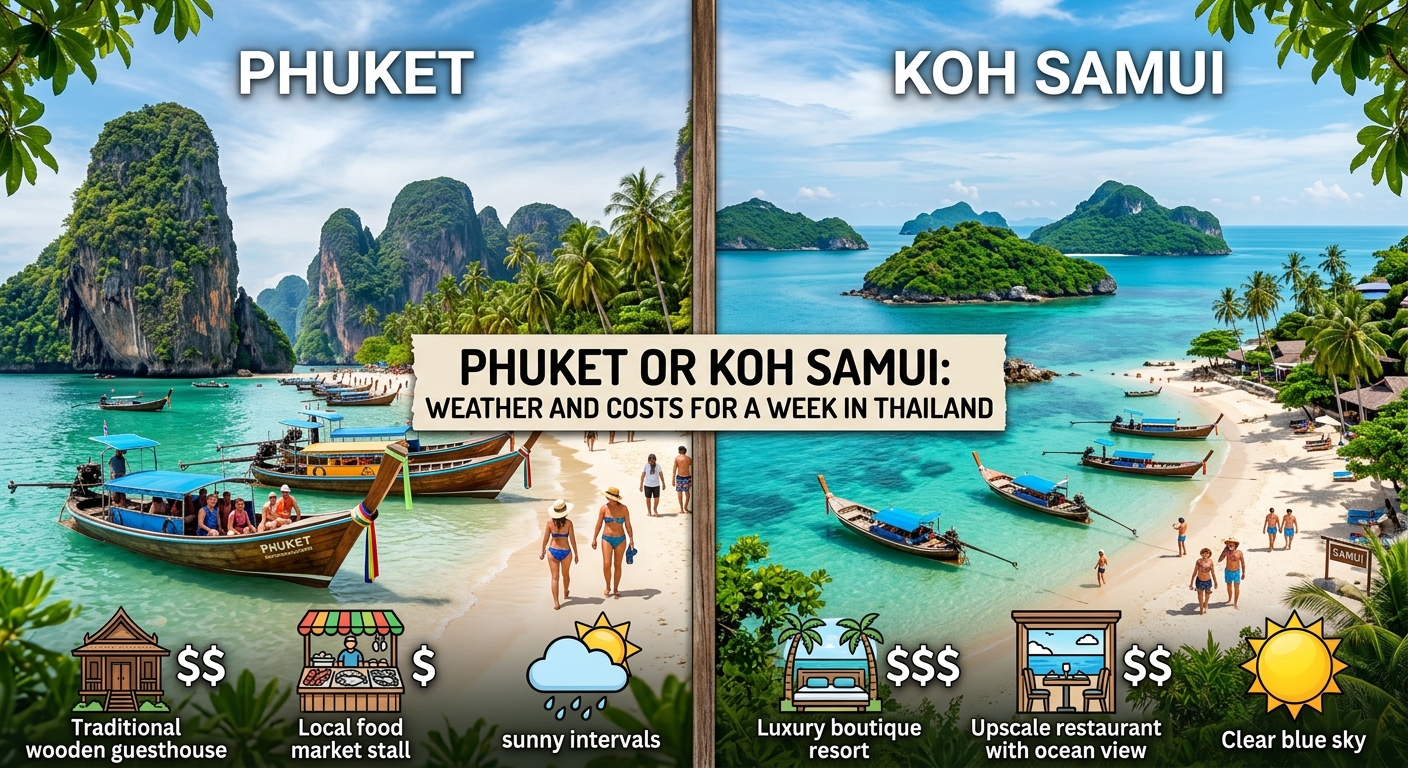
A cheap beach hotel stops feeling cheap when every dinner requires a taxi. A cheaper flight can lose its appeal after an airport bus, a ferry, and another transfer. For a week in Thailand, choosing between Phuket and Koh Samui means looking beyond room rates. Your travel month, arrival route, and ability to walk around your chosen neighborhood will shape both your spending and your time at the beach.
Your Week at a Glance
Phuket usually makes the stronger case from December through March, especially if flight choice and cheaper arrival options matter. Koh Samui often has the weather advantage from June through August, but direct flights and local rides can stretch the budget. For either island, choose a walkable beach base and price the complete journey before booking. Seven days is short enough that saving money through a complicated arrival can cost a meaningful share of your holiday.
Let Your Travel Month Choose the Coast
Phuket sits on Thailand’s Andaman coast. Koh Samui sits in the Gulf of Thailand. Their wetter periods do not line up neatly, which makes the month your first useful filter.
Seasonal patterns describe the odds. They cannot promise seven dry days. Rain can arrive as a passing shower or a longer spell, and rough water can affect swimming and boat trips even when the sky clears.
December Through February: Phuket Has the Clearer Case
Phuket generally enters its more reliable beach season during this period. December can still bring showers, but January and February are usually strong choices for travelers who want swimming and boat excursions to anchor the week.
That weather advantage attracts demand. Christmas, New Year, and other holiday periods can push accommodation and flight prices up sharply. Book early if your dates are fixed.
Koh Samui can remain unsettled into December. Conditions generally improve as the season progresses, making February a more reassuring choice than early December. If you have a December beach holiday and little flexibility, Phuket is usually the safer seasonal bet.
March and April: Both Work, With Heat as the Trade-Off
Both islands can suit a beach week in March. April is hotter, and showers become more relevant as weather patterns shift. A room with effective air conditioning may be worth more than a small nightly saving.
April also includes Songkran. Holiday demand can affect domestic transport and accommodation. Compare your actual dates rather than assuming that every week outside the winter peak is inexpensive.
May Through August: Koh Samui Often Has Better Beach Odds
Phuket becomes more exposed to the southwest monsoon from around May. Wet spells and rougher seas can interrupt west-coast swimming and excursions. Thailand’s Meteorological Department describes this seasonal mechanism in its explanation of monsoon patterns.
Koh Samui often offers better beach conditions during June, July, and August. Rain still happens, and summer holiday demand can keep popular hotels expensive. This is a weather advantage, not a guarantee of lower prices.
Phuket can offer attractive room deals in these months. Those deals make sense if you enjoy food, town visits, and pool time as much as beach swimming. They are less compelling if your entire week depends on calm water.
September Through November: Cheap Rooms Need Careful Scrutiny
September is often a difficult month for a weather-led Phuket trip. October is transitional, with substantial rain still possible. November generally brings improving conditions, although the change does not happen on a fixed date.
Koh Samui’s wetter period tends to build during October and peak around November, with unsettled weather sometimes continuing into December. A discounted November resort stay can be appealing, but it carries a real risk for travelers expecting daily beach time.
For late November, Phuket usually has the stronger seasonal case. For September or early October, keep activities flexible and avoid treating either island as a certain dry-weather choice.
Compare the Full Arrival Journey Before the Airfare
Phuket usually offers more flight choice, including domestic services and international arrivals. It also has a road connection to the mainland. You do not need a ferry to reach your hotel after flying into Phuket.
Koh Samui has its own airport, and flying directly there is the simplest arrival. Flight choice is narrower, and fares can consume a larger share of the trip budget. Price both islands for your dates, including checked bags and onward transfers. A headline fare is only one part of the journey.
Phuket Gives You More Ways to Control Transfer Costs
From Phuket airport, a private transfer to a popular west-coast beach is a substantial journey. Allow roughly 800 to 1,500 baht per vehicle as a planning estimate, depending on destination, service, and arrival time. Traffic can extend the trip.
A cheaper option serves the west-coast beach corridor. Airports of Thailand lists a 100-baht fare for its airport bus service. Check operating times, stops, and the walk to your hotel before relying on it. The saving is useful only if the route fits your arrival.
Koh Samui Offers a Faster Arrival or a Cheaper Mainland Route
Flying to Surat Thani and continuing by road and ferry can reduce the cost of reaching Samui. It also adds several moving parts. A combined airport transfer and boat ticket may warrant an allowance of about 500 to 1,000 baht per person each way, before any separate hotel transfer. Treat that as an estimate to check against a dated booking quote.
The road journey to the pier takes time. Conventional ferries from Donsak commonly take around 90 minutes to Samui, but that is only the crossing. Waiting, boarding, and travel from the arrival pier can turn the airport-to-hotel journey into four to six hours or longer.
Check which Samui pier your ticket uses. Lipa Noi, Nathon, and northern arrival points create different onward journeys. A low-cost ticket to a distant pier can leave you paying more for the final ride.
Before arrival, compare eSIMs for maps, transfer coordination, and booking access. Check Thailand destination coverage, your phone’s compatibility, and the plan’s activation rules. Reception can be unreliable during boat crossings. Download tickets, hotel details, and offline maps before leaving the mainland.
For a one-week stay, judge the mainland route by its total saving. If two travelers save only a modest amount after transfers, direct flights may justify the extra cost. Avoid a tight ferry-to-flight connection on your return, especially during unsettled weather.
Your Beach Base Determines the Local Transport Bill
Neither island is an easy place to move around cheaply all day without planning. Distances, traffic, and the location of your hotel matter more than the island’s overall size.
Phuket has useful bus routes, but they do not connect every beach conveniently. Samui has shared songthaews on main roads, yet fares and availability can depend on the route and time. Agree the fare before boarding. Do not assume a vehicle waiting outside a hotel will charge a shared-service price.
Choose Phuket for More Variety Within One Base
Patong has a dense selection of restaurants and nightlife. Kata and Karon can suit travelers who want beach access and plenty of nearby meals. Phuket Town works well for food and town visits, but it requires travel for west-coast beach days.
For private rides between tourist areas, set aside several hundred baht per journey. Longer trips can exceed 800 baht. Ride-hailing quotes can help you assess a fare, though availability and pickup arrangements vary.
Choose Samui for a More Settled Beach Routine
Central Chaweng and Lamai make it easier to reach restaurants and services on foot. Bophut suits travelers who want evening dining around Fisherman’s Village. Quiet resorts away from these centers can be appealing, but every meal outside the property may require transport.
Use about 300 to 700 baht as a provisional allowance for a private ride between nearby tourist areas. Longer cross-island journeys can cost more. Request airport or pier transfer quotes from your accommodation before booking.
Scooter rental can reduce daily transport spending, with basic rentals often budgeted around 250 to 400 baht a day before fuel. It should not be the foundation of your budget unless you already ride confidently and hold the required licence and permit. Check insurance coverage too. Walking distance is a more dependable saving for many visitors.
Build a Daily Budget Around How You Actually Travel
The estimates below are in Thai baht, per person per day. They assume two adults sharing a private room. They exclude flights, airport or pier transfers, insurance, and major paid excursions. These are planning allowances rather than live price quotes. Holiday dates, beachfront locations, and late bookings can push costs higher.
Daily Spending for Two Adults Sharing a Room
| Travel Style | Phuket per Person | Samui per Person | What the Budget Assumes |
|---|---|---|---|
| Careful Spending | 1,200 to 1,800 baht | 1,300 to 1,900 baht | Simple room, local meals, mostly walking, limited paid activities |
| Comfortable Midrange | 2,200 to 3,500 baht | 2,300 to 3,700 baht | Comfortable hotel, mixed dining, occasional private rides, modest extras |
| Resort Comfort | 4,500 baht or more | 4,500 baht or more | Higher-end accommodation, frequent private transport, resort dining |
A workable midrange example starts with a 2,400-baht room shared by two people. That means 1,200 baht each for accommodation. Add 650 baht for meals, 350 baht for transport, and 300 baht for drinks or smaller activities. The total is 2,500 baht per person per day, or 17,500 baht across seven days.
At that pace, two people would allow 35,000 baht for seven days on the island, then add their arrival costs and larger activities. Use your actual hotel-night count when calculating the final figure.
A shared ride can keep a couple within that transport allowance. A solo traveler paying the whole fare may need much more. Solo visitors also carry the full room cost unless they choose a hostel or another shared arrangement.
Local meals help control spending on both islands. Allow roughly 80 to 150 baht for a basic dish at a modest local restaurant. Tourist restaurants, seafood, alcohol, and resort meals can raise the bill quickly. Budget separately for a boat excursion, which can add several thousand baht per person once inclusions and fees are considered.
Keep One Base and Leave Room for Weather Changes
Splitting a week between Phuket and Samui usually weakens the value of both. Packing, transfers, and travel interrupt the stay. Choose one island and use the flexibility for a better beach day or a postponed excursion.
Book accommodation with enough nearby food choices to support several evenings without a vehicle. Then leave your most weather-sensitive activity open until you can assess conditions.
- Choose Phuket for a winter beach week when flight choice and easier access matter.
- Choose Samui for a summer beach week when its seasonal weather advantage justifies the arrival cost.
- Choose a walkable hotel location if taxis would otherwise become a daily expense.
- Keep a weather buffer before boat excursions and mainland flight connections.
- Compare the complete seven-day total, including bags, transfers, meals, and paid activities.
Put the Better Week Ahead of the Cheaper Room
Phuket is often the easier value choice. Flight competition, road access, and a wide accommodation range give you more ways to manage costs. Its case is strongest during the winter beach season.
Koh Samui becomes more compelling when your dates fall in the summer months and beach time is the priority. A higher airfare may buy a simpler arrival and better seasonal odds. That can be worth more than a discounted Phuket hotel.
Start with the month. Price the complete arrival. Choose a neighborhood where daily life works on foot. The better island is the one that gives you more usable days within your total budget.
Read next
-
 When to Visit Thailand, Bali, and China on an Extended Asia Itinerary
How to sync Thailand, Bali, and China into one itinerary, plus which months make all three destinations work at the same time.
When to Visit Thailand, Bali, and China on an Extended Asia Itinerary
How to sync Thailand, Bali, and China into one itinerary, plus which months make all three destinations work at the same time.
-
 Getting to Indonesia's Eastern Islands Without Routing Through Bali
Skip the Bali default. Here's how to reach Flores, Komodo, and Raja Ampat through Makassar, Lombok, and Surabaya with real costs.
Getting to Indonesia's Eastern Islands Without Routing Through Bali
Skip the Bali default. Here's how to reach Flores, Komodo, and Raja Ampat through Makassar, Lombok, and Surabaya with real costs.
-
 Bali, Lombok, or Nusa Penida — Ferry Routes, Real Costs, and How to Decide
Compare ferry routes, crossing times, and real ticket prices for Bali, Lombok, and Nusa Penida — then match the right island to your trip length and goals.
Bali, Lombok, or Nusa Penida — Ferry Routes, Real Costs, and How to Decide
Compare ferry routes, crossing times, and real ticket prices for Bali, Lombok, and Nusa Penida — then match the right island to your trip length and goals.